
Thanks to Kathleen Jacobs for bringing us another excellent book review and recommendation.
Memories are the architecture of our identity. —Harper Lee
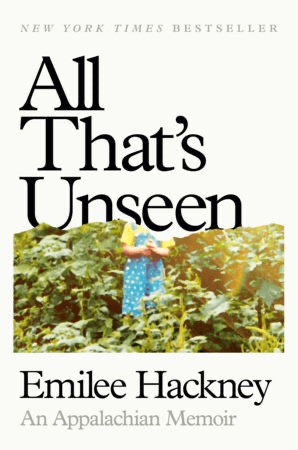
As I read Emilee Hackney’s spiritual memoir, All That’s Unseen: An Appalachian Memoir, I reflected on Lee’s words, as Hackney awakened my senses to all that contributes to our identity, all that plays a role in shaping it. What awakens our senses? What enriches? What dismantles? What brings about the changes we encounter as we search the myriad components that comprise our identity? For Hackney, the Appalachian culture and its people and all each of them brought to her table molded her choices. What we witness, feel deep in our marrow play significant roles in our ever-changing lives.
The day I walked into my neighborhood bookstore on the Upper East Side of Manhattan to pick up a good book to join me at dinner, the store’s manager handed me a copy of Hackney’s memoir, always knowing what will most probably resonate with me. I walked to the register, paid for the book, left the store, and walked across the street for an early dinner. I read the book through the appetizer, the entree, and a lemon tart. Nearly two hours later, I left, hoping to continue to read the book as I dodged traffic and a sea of pedestrians, headed home, knowing that I needed to close the book and choose safety. Once home, I continued to read until close to midnight, resuming my reading when the morning sun trailed through my window blinds. I stayed with the story until I turned the last page. I knew then that it would never leave me.
Hackney grew up in southwest Virginia, a hop, skip, and a jump from my home in West Virginia. In her memoir, she talks at length about her deep immersion in Pentecostalism; her destructive relationship with a man who was not who he pretended to be, upending everything she had come to believe in; and her own unraveling, leading up to her acceptance to Harvard. But what she finds there brings on even more isolation, as Appalachian stereotypes emerge. Her journey culminates with an awareness of the need for her to reinvent herself and her relationship with her home, faith, and values.
While some might see it as a coincidence, I recognized the arrival of Hackney’s memoir as divine intervention. My own spiritual memoir, Before the Cock Crows, would be released by year-end. It took several years to write it and several more to release it to the world. I had stopped production a few times, only to begin again. Reading Hackney’s memoir not only resonated with me on so many levels but also assured me that my own story was worth telling. I was filled with hope and gratitude.
I’m not a New Yorker. Yes, I live in the city, but the journey has been touch-and-go since 2022. My husband chose to move to the city (he had conducted business there for many years) in order to make certain that his business succeeded. I had lived in West Virginia most of my life; my husband was born there. His business relied heavily on the coal industry, which experienced a dramatic change over the years, never fully recovering. When he left for NYC, I stayed in WV, until a year ago when I joined him permanently. Like Hackney, I did not want to leave Appalachia and then I did and then I didn’t. I didn’t know where I belonged. What surprised me was the warm welcome I received from New Yorkers, whether I was enjoying a meal, browsing a shop, spending time in a library or a museum, or taking a walk in Central Park. Still, I yearned to return to WV, its culture, and yes, its rugged terrain. And as I neared the end of All That’s Unseen, I embraced Lee’s words. And while memories are most certainly an accounting of an individual’s experiences, they are, at their core, universal, connecting us one to the other.
Hackney’s personal journey to enlightenment, discovery, and truth not only invites us to travel with her vicariously but to light the way for others whose ignorance of Appalachia and its people is far too reaching, too deeply planted. She sets the stage for an uprooting that is long overdue.
The relentless cycle of leaving and returning to Appalachia can seem maddening, knowing, as Hackney points out, that Appalachians are never quite happy in the mountains and yet never quite happy beyond them. And yet we listen to the “whispers of possibility,” as they relate to a rebirth of the coal industry, “because you couldn’t not hope.”
At the author’s core is a deep desire to erect her own identity, one she constructs rather than one constructed by someone or something else. The connection she longs for is what each of us longs for. And connection is what makes all the difference. And as the sounds of silence and stillness found in Appalachia are juxtaposed alongside the unfamiliar, each of us finds our way. In the end, “Appalachia endured, always.”
Kathleen M. Jacobs holds an M.A. in Humanistic Studies. She lives and writes in New York City, answering every call to return home to West Virginia.

