
I’ve never liked petting zoos. Growing up, I would always find myself sneezing through clouds of alpaca fur and sheep wool to illuminate the way, like Moses parting the Red Sea. IT was always the goats that scared me the most; something about their beady-eyed glares and ever-greasy fur was deeply unsettling in a way that I couldn’t quite place.
This only got worse when I moved to a small town in Arizona at the age of nine, and started attending an outdoor school specializing in homesteading, called the Schoolhouse. At the Schoolhouse, chickens were more abundant than fellow children. We learned math by measuring ingredients for canning and pickling. The Schoolhouse was surrounded by neighboring ranges, which were full of cows and…you guessed it: goats. I would shiver at the fierce gazes from the neighbors’ goats, avoiding their line of sight as I weeded in the orchard.
When I was in seventh grade, the Schoolhouse go their own goats, a mother-daughter pair named Rosemary and Bessie. They’d turn up their noses when the teachers made me feed them grass, and instead slither along the fence with a skin-crawling shkshkshkshk sound. The goats would lock eyes with me, their unnerving rectangular pupils holding me frozen.
At a certain point, I grew used to the constant stares of small creatures, their gazes laced with disapproval and something else I couldn’t quite place. My Schoolhouse classmates had been cheerfully enjoying goat care for months, but I always spent more time with the chickens, since the chickens didn’t try to challenge me to staring contests. But eventually, I knew that I had to confront my fears. I went into the goat pen to pet the goats, and I forced myself to run my hands determinedly over their coarse fur. I had an epiphany when the goats began to soften at my fierce rubs on their backs; that something that I couldn’t quite place before? It was fear. The goats had been afraid of me. If I made myself comfortable with them, they became comfortable with me.
The goats were generous enough to share their milk with us, and we started making goat milk ice cream. It was shockingly good–that is, until my classmate, while enjoying her bowl of ice cream, pulled a wiry, gray goat hair from her lips. We tried not to screech at the thought of eating a part of the goats’ coat of hair, but we all inspected our ice cream closely after that.
Despite what could’ve grown into a new friendship between me and the two goats, their time at the Schoolhouse was tragically cut short. Mid-way through eighth grade, a bear broke into the goat pen, and this time, it was a bear that pulled many wiry, gray goat hairs from its lips…after making a meal out of our poor goats. I walked into school the next day, only to see the grief-stricken faces of my classmates. “The goats have passed away,” my teach whispered, the still-fresh shock on her face. She had been the one to discover what was left of the goats, the one to attempt to give the bits and pieces an honorable burial.
Up until that moment, I’d had the bad habit of still thinking of California as my home, even though I had moved years earlier. But watching the sadness of my peers, I had an epiphany: this was my home, because these people were my community. This was where I belonged, sharing in my classmates’ grief. I’m sure we were a strange sight, eleven middle schoolers all sitting in a circle, with our teacher in the middle. Whether or not the goats knew it, they had made many sacrifices for us, and had brought us together. That moment of unity served as a catalyst for my understanding that I was really home, and I needed to make others feel that way too.
In ninth grade, I found myself at a new school, but in a very different context. I had been hired as teen teaching artist by a local arts program, and our first few months were spent teaching art and drama classes at local elementary schools in town. While the kids were sweet and eager to do art with us, it could be a little overwhelming whenever we entered the classroom. A wave of sound would drench us as the yelled excitedly, calling our names and asking us questions. Some of them would jump out of their seats to hug us as we walked by.
The next school we taught at was an elementary school on the Apache Reservation, fifteen minutes away from my home. It was so different; most of the kids at this school were quiet and merely observed us from a distance, instead of swarming us like ants on a piece of watermelon. The ones who did come closer to us were far and few between, but they were excited, and that was more than enough.
After the first week at this school, I realized that these kids wouldn’t necessarily come to me. So I went to them. By the second week, we shared quiet smiles and contented crafting, side by side. I remembered the goats: If I’m comfortable with them, it will help them be comfortable with me. I had developed a mutual understanding with the shyer kids, and we would have hushed conversations while they made origami hearts.
I also grew close with some of the less reserved kids, namely Ramona, hilariously honest second grader. Ramona loved improv games. She was the type of kid who would say something extremely humbling with zero ill intentions, like, “Why is your hair like that? It reminds me of the bad guy from The Lorax.”
There was also Dylan, who loved singing and dancing with us–not even for the sake of performing, but just because he loved doing it. He was always so enthusiastic about all of our activities, and his raw joy made all our preparation worth it. I helped him make a paper tiger once, and he talked about how much he loves the jungle while making the paper tiger “pounce” on my hand.
One of my best memories was with a kid named Eli, who was in kindergarten and very cheery. He always had a runny nose, and would talk a lot about astronauts. But it took time to learn about his love of space. He was one of the shyest kids in the class, and while he’d participate in games with us, he always looked vaguely stressed. One day though, I brought in homemade stickers. I had designed and printed out stickers of their class pet, a guinea pig named Cinnamon. Eli drew a galaxy and a multitude of planets on his paper as a background for Cinnamon and created a storyline for the guinea pigs’ adventure in space. He had me take a video of Cinnamon soaring through stars and meteors, and it’s still saved as a favorite in my camera roll.
I’ve spent a lot of time in a tiny rural area that counts as nothing more than a dot on the map, a dot that you have to zoom in to find. But after seven years here, I’ve learned that it means a lot more than that to me. I had to make it into my home, instead of just waiting for it to happen. Through my years of learning how to connect with a wide variety of people who are so different from me, I’ve had a realization. It wasn’t the goats that held me back; it was my fear. And once I grew comfortable with the animals, I could appreciate the goats, Rosemary and Bessie, in their full glory: small, gray animals who gave up more than they will ever know, so that I could find a home.
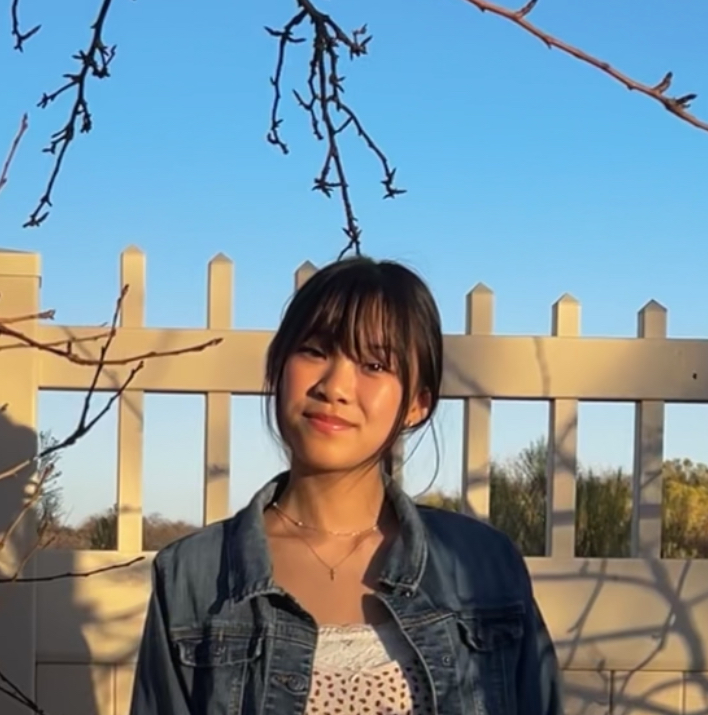
Sallie Choi is a sophomore in high school who recently discovered how much she enjoys sharing her voice through personal narratives. She lives in rural Arizona and between performing her favorite songs with her band on the bass and writing all sorts of pieces, she loves art in all forms. Sallie enjoys spending her free time baking with friends, teaching art classes to kids, and both listening to and creating music.
 Dr. Parton's Literacy In Place