
This is the first winter I’ve been back in the Midwest after eight years of living in Texas. On a particularly cold day recently, I found myself with a hankering for chicken noodles, mashed taters, and sweet corn, so of course I made it. Then I sent a text to my mama, mamaw, and sister that said, “Midwestern winters call for Midwestern dinners.” After seeing the theme of this month’s episode of Read Appalachia, I started thinking about how I never once craved this food while living in Texas. Not only that, but as I shredded the chicken and mashed the taters, I was flooded with memories of being up on stools and chairs in my mom and mamaw’s kitchens “helping” to make dinner.
Maybe the weather didn’t get cold enough for long enough. Or maybe there’s just something about being back in my home state that made me want home food more than I had when living away from it. Perhaps there’s something in the exchange of molecules in the air or the way the ground feels and smells. I don’t know.
What I do know is that place and food and people are deeply intertwined, and reading explorations of what that can and does look like for other folks through literature provides important opportunities for young readers to think about their own foodways and cultures–not only about how they view and understand them but as connected to the stories folks outside of their culture tell about them too.
In this month’s Read Appalachia episode, Kendra talked more about the impetus for this month’s theme including her own relationship with her home foodways. I’ll let her explain more about it here:
ON THIS MONTH’S THEME FROM KENDRA:
One of my favorite memories of my grandfather was when he’d come back to their cabin with fresh tomatoes straight from his garden. He’d wash them, slice them, sprinkle them with salt and eat them raw. He and my grandma would sit on their back porch and share a plate of tomatoes as they watched the world go by. They taught me food doesn’t have to be fancy or extravagant to be delicious, and food is meant to be shared with those we love. And that’s worth celebrating.
BOOK RECOMMENDATIONS
For this month, I (Chea) have selected books written for young people that feature food and foodways in a salient way. Actually, the past theme of the Literacy In Place Rural Teen Writing Contest invited writers to submit pieces in which they think about food as part of their rural culture(s). If interested, you can read about the winners here.
YOUNG ADULT RECOMMENDATION: Braiding Sweetgrass by Robin Wall Kimmerer, Monique Gray Smith, and illustrated by Nicole Neidhardt

In the original version of Braiding Sweetgrass, botanist Robin Wall Kimmerer demonstrated how all living things―from strawberries and maple trees to fish and lichen―provide us with gifts and lessons every day. Combining memoir and science, Kimmerer explored how Native and Indigenous ways of thinking, being, and knowing in the world can be called upon in our modern day and age to help us live more sustainably. There are important life lessons in the taste of strawberries, the growth of the Three Sisters (corn, beans, and squash), and the harvesting of maple syrup. How we grow and access food is incredibly connected to place and culture and connects us to one another. This version has been adapted for young adults by Monique Gray Smith, and reinforces how wider ecological understanding stems from listening to the earth’s oldest teachers: the plants and around us and the gifts of food and medicine that they offer us. Informative sidebars, reflection questions, and art from illustrator Nicole Neidhardt brings brings Native and Indigenous wisdom, scientific knowledge, and the lessons of food/plant life to young folks.
MIDDLE GRADE RECOMMENDATION: Stepping Stones by Lucy Knisley
Stepping Stones is a graphic novel that follows the story of Jen whose life is uprooted after suddenly moving to the country. She didn’t want to leave her friends and dad in the city. She doesn’t much care for Peapod Farm, her mom’s new boyfriend, or her new “sisters”. As she struggles to learn new chores—cleaning the chicken coop and keeping up with the customers at the local farmers’ market—Jen misses her old life. Dealing with insecurities about her place in her new family and new community, Jen gives us a peek into where food comes from and works to determine where she belongs. In a story inspired from her own childhood, New York Times bestselling author Lucy Knisley brings to life a story of an amazing journey of unlikely friends, sisters, and home.

PICTURE BOOK RECOMMENDATION: Cook-a-Doodle-Doo by Janet Stevens and Susan Stevens Crummel
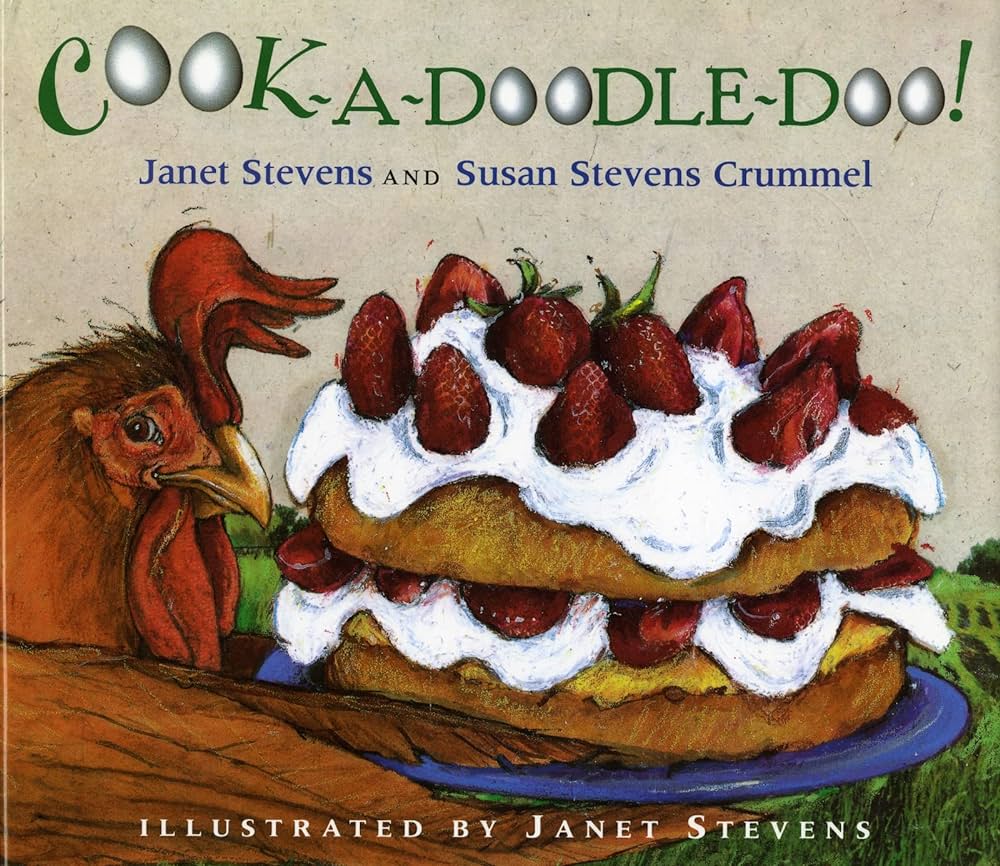
Rooster is tired of eating chicken feed. So, he recruits his friends—Turtle, Iguana, and Potbellied Pig—to make the most magnificent and delicious strawberry shortcake the world has ever seen. There’s just one problem: none of them know how to bake. Determined to succeed, the unlikely team forges bravely ahead. With Rooster’s help, they figure out how to measure flour (hint: you don’t use a ruler) and how to beat an egg (hint: not with a baseball bat). They battle with Pig to keep him from eating all the ingredients as they work together to follow an old family recipe and make the best strawberry shortcake they (and you!) have ever tasted. Cooking confusion and unruly friends make this a hilarious story, but it’s so much more than that. The book includes the author’s family recipe for strawberry shortcake that you and young readers can make after enjoying the story. This story does double duty by introducing readers to food and then providing them with the tools to make it together. Perhaps the author’s old family recipe will become yours too, and the legacy of strawberry shortcake may continue far and wide.
Happy reading!
Check out the latest Read Appalachia Podcast. and learn more about Read Appalachia at https://www.readappalachia.com/
Follow Read Appalachia on Instagram, Twitter, and Facebook @readappalachia.
Follow Kendra on Instagram and Twitter @kdwinchester.
 Dr. Parton's Literacy In Place